
Lithium vs LPG Forklifts: Which Suits Your Business?
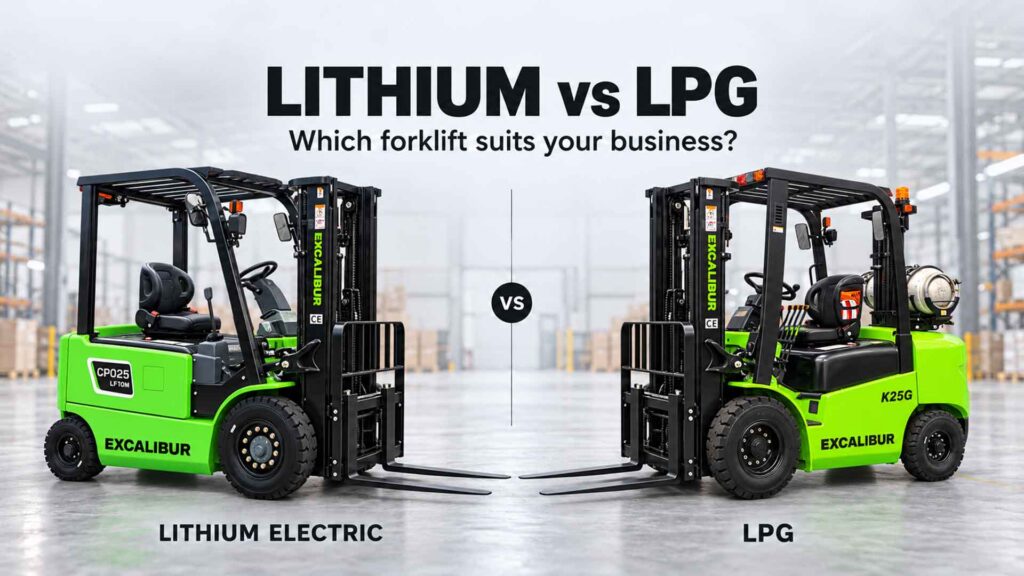
Choosing between lithium and LPG forklifts starts with understanding how your business works. Your loads, operating environment, daily usage and access to charging or fuel all influence which machine is suitable.
The short answer
Consider lithium when avoiding engine exhaust and arranging suitable charging are priorities. Consider LPG where site conditions and practical fuel arrangements support its use. Compare equivalent machines for your actual workload.
In this guide
1. Lithium vs LPG forklifts: a quick comparsion
Consideration
Lithium electric
LPG
Energy supply
Battery and compatible charger
LPG cylinder supply
Exhaust at point of use
No engine exhaust
Engine exhaust requires assessment
Work planning
Suitable charging periods
Cylinder supply and changeovers
Maintenance
Truck, battery and charger
Truck, engine and fuel system
2. Start with your operating environment
Indoor warehouses and enclosed areas
A lithium electric forklift avoids the engine exhaust associated with LPG equipment. That can be an important selection factor for indoor work.
LPG forklifts produce exhaust gases, including carbon monoxide. WorkSafe Victoria identifies the risk of fumes building up when gas-powered forklifts operate indoors, including in loading docks, shipping containers and cold stores.
Do not assume an LPG forklift is suitable indoors simply because a roller door is open. Assess the actual work area and exposure risks, and select equipment and controls accordingly.
Outdoor and mixed-use sites
For equipment moving between a warehouse and a yard, check the specific model’s suitability for the route.
Consider surface condition, gradients, drainage, weather exposure, tyres and ground clearance. Outdoor work does not automatically require LPG, and an electric forklift should not automatically be assumed suitable for wet or uneven conditions.
Ask your supplier to confirm the manufacturer’s operating limits for the machine being proposed.
3. Match charging or refuelling to your workload
Planning for a lithium forklift
Start with a realistic picture of usage. A forklift moving occasional pallets has different energy requirements from one travelling and lifting throughout the day.
Before choosing a lithium model, confirm:
Battery capacity and expected runtime for your application.
The compatible charger and its electrical requirements.
Available charging periods between tasks or shifts.
Whether the battery and charger support opportunity charging.
Charging location and the manufacturer’s temperature limits.
Opportunity charging means charging during suitable breaks. It can help some operations, but the charging strategy must match the battery, charger and energy demand. Do not assume every lithium forklift will complete every shift on one charge.
Planning for an LPG forklift
For an LPG model, consider how cylinders will be supplied, stored and changed.
Ask how much operating time you can reasonably expect from a cylinder under your workload. Also consider cylinder availability, trained personnel, handling arrangements and what happens if a delivery is delayed.
A practical fuel supply plan matters as much as the machine’s purchase price.
4. Compare maintenance requirements
Lithium and LPG forklifts have different power systems, but both remain working machines that need ongoing care.
A lithium electric forklift still requires attention to items such as tyres, brakes, steering, forks, mast components and hydraulics. Its battery system, cables, connectors and charger must also be checked and maintained as specified.
An LPG forklift has those mechanical systems plus an engine and fuel system, with servicing requirements set by the manufacturer.
When comparing quotes, ask for:
The servicing schedule for each model.
Estimated scheduled servicing costs based on your usage.
Warranty conditions and maintenance obligations.
Parts availability and service arrangements.
Any separate battery, charger or engine warranty terms.
Compare the actual maintenance schedules rather than relying on broad claims about one fuel type.
5. Compare ownership costs, not just purchase price
The purchase price is only one part of the comparison.
For lithium equipment, include the forklift, battery and charger, any electrical work, electricity consumption and servicing. Over a longer ownership period, battery condition, warranty coverage and possible replacement costs also matter.
For LPG equipment, include the forklift, fuel consumption, cylinder arrangements, servicing and any site measures required for its use.
A useful comparison is:
Ownership cost = purchase and setup costs + energy + servicing and repairs + other operating costs − expected resale value.
Use the same ownership period and workload for both options. Treat future repair costs and resale values as estimates, and test how the result changes if they differ from expectations.
A practical way to estimate energy costs
For a lithium forklift:
Annual electricity cost = measured charging electricity per working day × electricity tariff × working days.
Use electricity measured at the charger supply where possible, so charging losses are included.
For an LPG forklift:
Annual fuel cost = average cylinders used per week × cost per cylinder × operating weeks.
Use consistent cylinder sizes and include any delivery or rental charges.
These calculations compare energy costs only. Add servicing, infrastructure and other costs before deciding which option is more economical for your business.
6. Check the machine specifications
Two forklifts with the same nominal capacity may still differ in suitability.
Compare:
Rated capacity at the required load centre and lift height.
Residual capacity with the selected mast and attachments.
Lowered mast height and overhead clearances.
Aisle requirements for your actual pallet and load dimensions.
Tyres, ground clearance and permitted gradients.
Overall dimensions and truck weight.
Charging or fuel arrangements.
Warranty, servicing and parts support.
For example, a capacity rating alone does not confirm that a forklift can lift your particular load to your highest rack position. Ask for the applicable capacity information for the proposed configuration.
Which option deserves a closer look?
Investigate lithium electric forklifts when avoiding engine exhaust at the point of use is important and your site can accommodate suitable charging equipment and routines.
Investigate LPG forklifts when your operating environment is suitable, fuel supply arrangements are practical and cylinder changeovers fit your work patterns.
If either option could do the job, compare equivalent models using your own operating hours, supplier quotes and site requirements.
Explore Excalibur lithium electric forklifts or compare our LPG and diesel forklift range.
Frequently asked questions
Are lithium forklifts cheaper to run than LPG forklifts?
They can be, but the result depends on electricity and LPG prices, utilisation, energy consumption, servicing and setup costs. Compare equivalent machines using your own workload rather than relying on a fixed savings percentage.
Can a lithium forklift replace an LPG forklift?
Potentially, provided the proposed machine meets your capacity, lift-height, attachment and site requirements. Battery capacity and charging opportunities must also support the required workload.
Can LPG forklifts be used indoors?
Indoor use requires careful assessment of exhaust exposure and ventilation. LPG forklifts can produce hazardous carbon monoxide. Do not treat LPG as an automatically suitable indoor option; refer to workplace safety guidance and assess the actual operating conditions.
Does a lithium forklift need maintenance?
Yes. The forklift’s mechanical and electrical systems still require inspections and servicing. Follow the maintenance requirements for the truck, battery and charger.
Can I charge a lithium forklift from a standard power point?
That depends on the charger supplied with the machine. Confirm its voltage, phase, current and connection requirements before purchasing. Have a qualified electrician assess the installation where necessary.
Get advice on the right forklift for your operation
Excalibur Machinery supplies Excalibur-branded forklifts manufactured by JAC, with local equipment advice and after-sales support.
Tell us your heaviest load, required lift height, working environment and typical hours of use. We can help you compare suitable models and explain their specifications, charging or fuel requirements, and support arrangements. Speak to the Excalibur team or call 1300 039 225.Get advice on the right forklift for your operations.
Tell us about your operation. We’ll recommend the right machine, walk you through pricing, and arrange a demonstration. No pressure, no jargon.